Salisbury (Sarum) Probus Club
Sarum Probus Club is an organisation for retired men living in the Salisbury Area.
Previous Meetings 2025
Commonwealth War Graves Commission
14th March 2025

On 14th
March Christopher Brown spoke to the Club about the history and work of
the Commonwealth Graves Commission.
Inspired by his mother’s concern for a great
uncle who had perished in Iraq in 1916 and seeing the lists of the
fallen on the Town Memorial in Wimborne Minster, Christopher became
interested in where dead service personnel were buried. It led to
research into the work of the CWGC and to him becoming a volunteer
speaker for the organisation.
He discovered that the Commission cares for
headstones and memorials in 23,000 locations worldwide. It was founded
in 1916 and supported by 6 Commonwealth Governments – Uk, Canada,
Australia, New Zealand India and South Africa. The policy was agreed
early in the First World War that repatriation of the dead was
impractical. The fallen were at first buried in rough graves, near where
they fell. After the war the bodies were collected into Cemeteries and,
each grave marked with a standard headstone, whatever the rank of the
person interred. This was the first time the dead of Battles were
commemorated in any official way; no formal memorials exist for earlier
conflicts.
The dead of the Second World War were included,
and memorials exist all over the world for the fallen of these battles.
Statutes limited and still limit the CWGC to look after memorials of the
dead of the two World Wars. Those who died in other conflicts are dealt
with by the Ministry of Defence.
Where known each headstone bears basic
information about the departed and may include a personal tribute by
their family. Where the person is unknown the stone records this fact.
Those who died in either conflict but whose remains were never found or
identified, are commemorated on memorials, some large, others more
modest. All are cared for by the CWGC.
The organisation is always in need of volunteers
to help with the work of maintaining graves and spreading information
about their work.
Christopher received a warm ovation for a very
detailed and carefully prepared talk.

On 11th April Group Captain Ron Burrows gave us a
fascinating presentation of his years as an RAF pilot under the
heading “Testing Fast Jets 1962 – 1988.” He emphasised that his talk
was largely about his experience of the historic RAF, rather than an
account of how it operates today.
Ron first served as a pilot in Aden; there he
trained for many hours on a variety of jet planes. There the British had
a presence striving to prevent the ingress of insurgents from
surrounding Arab States. Once trained, he joined the squadrons on round
the clock duty supporting the British Army. At that time the airport in
Aden was one of the busiest in the world. With no modern satellite
devices, the pilots had to find targets marked by personnel on the
ground who laid day glo strips or created smoke indicators.
Ron remained in Aden for 2 years and then
returned to the UK where he spent time as an instructor before
progressing to his main role as a test pilot, at first with the United
States Navy and then in England at Boscombe Down. The main aim was to
make sure that the aircraft produced by designated suppliers matched the
claims of those suppliers and, also met the needs of the Military
Services.
If a plane was designed to perform in very low
temperatures then it was put through icing tests to see it performed
satisfactorily. Cold temperatures for instance can cause problems with
the hydraulics on an aircraft. Similarly tests were devised to test the
performance of aircraft in very hot and very dusty environments.
Obviously a test pilot flying a new design of
aircraft with no simulators available to prepare him and only a few
hours in which to study the instruction manual, ran risks and often
there were unexpected outcomes; noses that suddenly rose or dropped,
landing procedures that didn’t quite go as planned. Ron had a few narrow
escapes and admits he was lucky.
As well as testing the flight of aircraft the
Base at Boscombe Down was responsible for testing ejector seats and
conducting trials on missiles to discover the best way to launch them
from aircraft like the Jaguar that could be carrying a load as heavy as
a World War 2 Lancaster bomber.
Eventually Ron retired, largely unscathed and
had time to present talks like the one given to us. It was fascinating
and members thanked Ron for giving time to share the obvious enthusiasm
he still has for the subject.

On 9th May Chris Walker, a musician
himself spoke to us about the Great American Songbook which is a loose
term covering many American songs of the first half of the 20th
Century. It includes Tin Pan Alley, Broadway Musicals and Theatre;
containing some of the greatest and most enduring popular songs ever
written.
Chris illustrated his talk by introducing ten
lyricists and composers. Some like Cole Porter wrote both lyrics and
tunes, others like George and Ira Gershwin or Hoagy Carmichael and
Johnny Mercer collaborated, one writing the music the other the lyrics.
First we were introduced to the Gershwin
brothers who produced “Swanee” and “Rhapsody
in Blue” and Chris concluded by playing us a clip of one of their
most delightful songs “I’ve got rhythm.”
Cole Porter was remembered for the famous “I get
a kick out of you.” He also wrote a multitude of songs like “Anything
Goes,” but, sadly, following an accident in 1937 his later years were
marked by decline.
Chris went on to mention other great songwriters
and included with each writer a clip of one of his well-known songs. The
proof of the success of these writers is that their songs entered the
repertoires of singers like Frank Sinatra and Nat King Cole. And their
songs live on. Who has not heard of “Come fly with me” a song by Jimmy
Van Heusen popularised by Frank Sinatra? or “What a Wonderful World,”
one of Louis Armstrong’s greatest hits still heard regularly today.
The music of this era was so great that many of
today’s stars like Rod Stewart and Michael Buble have, in recent years,
revived public interest in them. The Club was grateful to hear this and
very thankful to Chris Walker for giving such a stimulating talk.
Sinking of Bismark
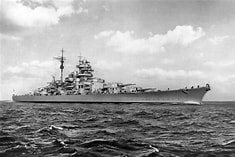
Sinking of Bismark May 1941
On11th July David
Bickerton, whose grandfather sailed with the Naval Group that hunted and
destroyed the Bismark, gave us a fascinating, detailed account of the
Royal Navy’s operation.
Bismark was a
battleship built supposedly under terms agreed between Britain and
Germany, subsequent to an easing of the very tight restrictions imposed
by the Allies at the end of World War 1. In fact, Bismark exceeded the
terms of the agreement in tonnage, size and number of guns, as did
several other ships built for the German Navy. Britain stuck more
rigidly to the Agreement and found itself with ships inferior in many
respects to their German counterparts.
The Royal Navy was
especially concerned that these powerful ships would wreak havoc with
the vital Atlantic convoys and they kept them under close observation,
anxious to know when they left harbour. Information came in May 1941
that Bismark and the heavy cruiser Prince Eugen had left their base and
appeared to be heading westwards to the Atlantic.
Two cruisers Norfolk
and Suffolk had been ordered to patrol the area around Iceland where it
was expected that the ships would pass. Once spotted, The Home Fleet,
ordered that two Battleships along with cruisers in support to attack
Bismark and Prince Eugen as they sailed southwards through the Denmark
Straits, west of Iceland. HMS Hood and HMS Prince of Wales moved to
intercept and a deadly exchange took place in which Hood was sunk and
the Prince of Wales damaged. The Bismark had also suffered some damage
in the exchange and having detached Prince Eugen, Bismark headed towards
Brest for repairs.
Prime Minister
Winston Churchill ordered that Bismark must be sunk at all costs, but
many British ships were too far away to be of immediate help. The Prince
of Wales, with some of its damage repaired and the Norfolk and Suffolk
were ordered to engage while other Naval Groups came to their
assistance.
After attacks by
Swordfish torpedo bombers from the aircraft carrier Ark Royal, the
Bismark rudders sustained heavy damage, which slowed Bismark so much
that the various pursuing groups were, despite very low fuel, able to
catch up.
Once within range,
the battleships, cruisers and destroyers circled the crippled Bismark,
and despite pleas for the killing to stop, carried out their orders
until Bismark sank.
Of the crew of over
2200,115 survived and were picked up by various ships, but the fear of
possible U boat attacks limited the number who could be saved.
Richard Hutley
The New Forest in World War 2.
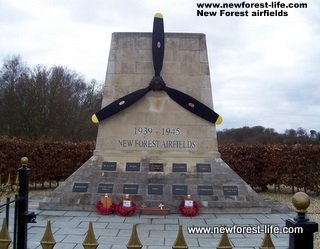
On 12th September Marc Heighway, a
man who has spent most of his life studying the New Forest in Hampshire
spoke to the club about the effects of World War 2 on the area. When we
think of the New Forest, we tend to conjure in our minds pictures of
unspoilt heathland and unbroken woodland. We never really associate it
with military events in the way we associate Salisbury Plain. But during
World War 2 the whole forest was requisitioned by the War Office and
there is no village which does not have traces of military usage.
The New Forest was an area relatively low in
population and testing and training could be carried on with less
interference in people’s lives than elsewhere.
So, at Ashley Walk, near Fordingbridge bombs
were tested, including Barnes Wallace’s famous bouncing bomb. The Forest
Commoners received agreed compensation, and the site was taken over.
Remains of a nearby bomb shelter, used to test the destructive blast of
ordinance, and craters, now morphed into wildlife ponds, still stand as
witnesses to this.
The Forest in the south adjoins the coast and
the War Cabinet led by Churchill, greatly feared that this unprotected
coast might be an attractive place for Hitler’s invasion. Villages like
Beaulieu were equipped with anti-tank blocks and, all along
the coast,
dragon’s teeth and machine gun emplacements were built. The concrete
bases can still be seen today. In Beaulieu itself the Dairy House was
adapted to be a gun pill box and the structures built remain.
There is much evidence of air activity still in
evidence. At Ipsley cross roads the remains of an Observer post can be
seen and there are scattered parts of enemy aircraft shot down all over
the Forest. Special airfields
were built primarily for planes bringing in equipment for the D Day
invasion and concrete still marks the places.
Add to this the remains of searchlight
positions, beach scaffolding, POW camps and a whole host of other war
time paraphernalia and we can see what a fascinating place the New
Forest is for those interested in its wartime history.
The Myth of Atlantis.”
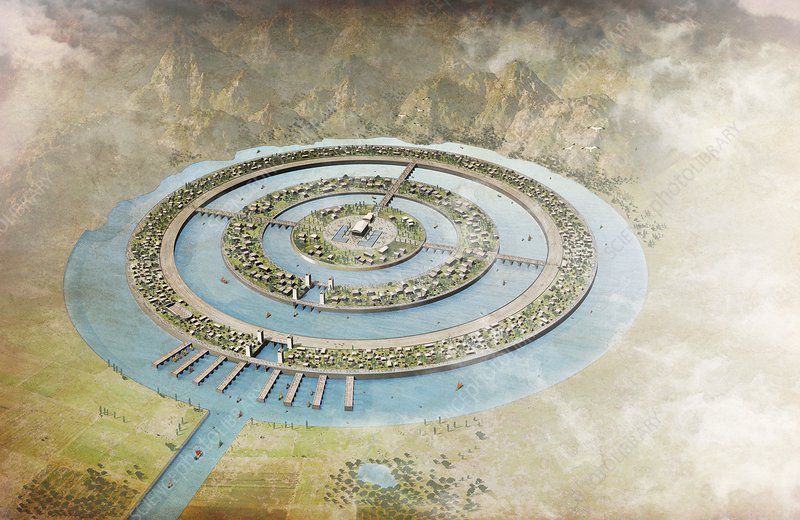
Most of us have heard the name Atlantis and know
that it refers to a city supposedly buried deep under the Atlantic
Ocean, lost in a terrible cataclysmic flood. Most of us probably also
think it is one of the legends of ancient Greece based on tales about
the Gods and elaborated by countless story tellers.
On 10th October Richard Hutley spoke
to Sarum Probus Club on this subject and presented the evidence for his
belief that the existence of Atlantis was more than just a myth.
Atlantis is mentioned by several early writers
but the best known is the philosopher Plato who lived in Athens in the
fourth century BC. He wrote many books but in two that survive he
mentions an ancient city state somewhere in the east Atlantic off the
coast of Spain. It stood on an island 227miles by 340, with 9 subsidiary
islands. Plato claimed his information originated with Solon, a scholar
of the 6th century BC who had met a priest who kept alive
knowledge of the ancients. Atlantis was destroyed in a flood which
covered the whole earth and mankind had to rebuild his life afresh.
Plato’s sources suggested the flood occurred about 12000 years ago. What
makes this intriguing is that there is considerable support for the idea
of a flood at about that time when the ice from the last ice age melted.
Myths like the “epic of Gilgamesh” or the Old Testament of Noah are
among many stories of a cataclysmic flood in this period. Estimates
reckon that waters would have risen about 200 metres over the whole
earth at this time.
Trying to identify where Atlantis may have been
has led to much speculation. Richard went through a number of possible
sites, but most seem to favour the Azores. These are situated off the
coast of Spain and, if the sea level could be dropped 200 metres, it is
reckoned a sizeable island, about the size of the UK, would appear.
Obviously more investigation is needed.
One other interesting idea is that, if civilisation existed before the flood 12000 years ago, much earlier than ever assumed before, knowledge from that period must be taken into account when viewing later structures. The pyramids could well be more than just tombs for Pharaohs; they could reflect an interest in cosmology developed in a previous era, by those who lived long before the Pharaohs. And there are other structures in the world which would merit more scrutiny. There is evidence for instance that Ancient structures in Japan, now submerged, precede the deluge of 12000 BC. The talk was altogether fascinating and, although much of Richard’s talk remains , on his own admission, speculative, Club members were left with much to talk and think about.
Jeff Evans "TV and Sport."
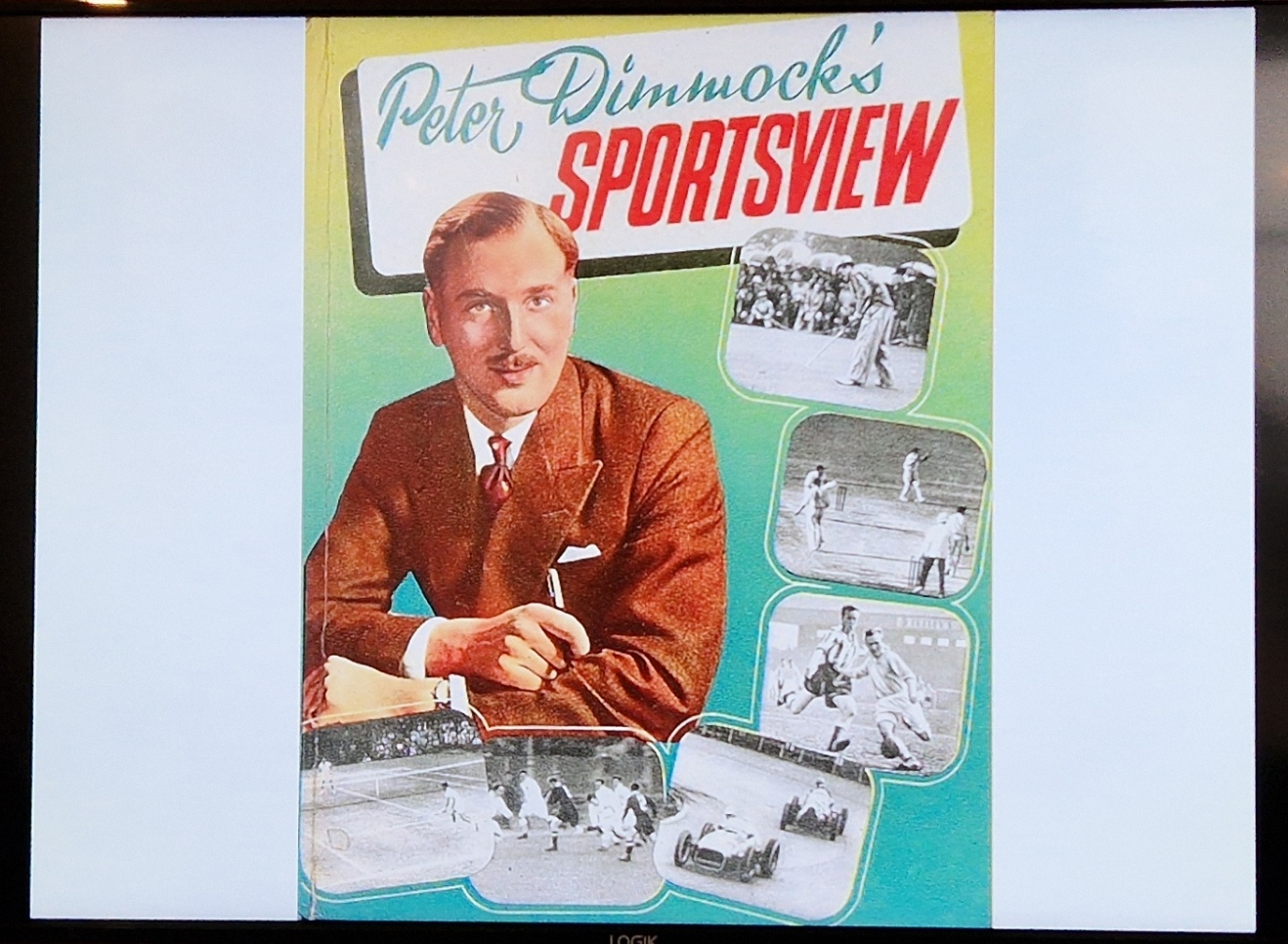
On 14th November, Jeff Evans, a
freelance journalist and TV historian, gave us a fascinating insight
into the way television has interacted with sport over the past century
under the title “They think it is all over.”
When BBC Television first began in 1936
transmission was from Alexander Palace just north of London, there was
no real place for sport. The idea of filming outside was way beyond the
equipment available, as was sending signals from a sports ground back to
the base. In 1937 the Corporation was persuaded to cover the tennis
tournament at Wimbledon but there were concerns about buildings
interfering with the transmission of the signal. In particular, the
electronic equipment in a hospital en route caused difficulties. Later
that year a football match was broadcast from Arsenal and the next year
the Cup Final and Boat Race were covered. At the latter only two cameras
were available so most of the race was sound only.
Then came the War and things stood still. In the
early post war period the old prewar equipment was still in use and many
sports broadcasts were only partially televised. The appointment of
Peter Dimmock to take charge of Outside Broadcasts led to huge changes.
Better cameras were purchased, more sports events covered, but his
biggest success was that he was put in charge of broadcasting the
Coronation in 1953. This led to many more people buying television sets.
In 1954 Dimmock started “Sportsview”, a Thursday night programme which
pulled together the action from several sports in the preceding week.
Sport was now firmly on the BBC but it wasn’t until 1958 that live
events were introduced by another big personality David Coleman.
“Grandstand” on a Saturday afternoon brought news of teams as they
played and famously broadcast the results as they came in on a
teleprinter.
The launch of ITV in 1955 introduced an element
of competition into TV sport. ITV saw itself as the working man’s
channel and introduced sports which had not previously been broadcast.
As well as football, boxing, horse racing and Rugby League
were among those Eamonn Andrews
presented in his Saturday programme “World of Sport.” The racing
elements gave betting information and the football results noted the
pools significance of relevant matches. The “World of Sport” introduced
the practice of sports practitioners and enthusiasts, especially
controversial ones, commenting on events covered. Because the BBC still
dominated the major sporting events ITV brought in American sports and
programmes from other countries.
By 1964 BBC2 had started and there was space on
the new channel for “Match of the Day”. And with the advent of colour
television the Wimbledon Tournament was one of the first to be covered.
In 1969 Pot Black was able to take advantage of the colour environment
and the image of snooker was forever changed by showing the balls in
colour and by moving games from the smoky, seedy clubs to the Sheffield
Crucible Theatre.
And now of course TV coverage of sport has
changed yet again with the establishment of digital channels like Sky,
channels with more money than their terrestrial rivals. While the BBC
now shows less sport than in the past it still retains the “Crown
Jewels” like the FA Cup Final and Wimbledon. How long this will last we
do not know.
Thank you Jeff for such a detailed and
fascinating talk which this
summary hardly does justice to.
For more previous meetings 2019-21 2021 2021-2 2022 2023 2024 2026
For more recent talks click here